

If you’ve ever wondered what the worst-case scenario for a rent increase looks like, a landlord in Manchester has kindly volunteered to show you.
He asked his tenant for an extra £50 a month. She took it to a tribunal, which decided the flat was actually worth £200 a month less than he was already charging.
So instead of £600 a year more, he’s now getting £2,400 a year less.
It’s one of the first high-profile challenges to surface since the Renters’ Rights Act came into effect, and housing minister Matthew Pennycook has already held it up on X as proof that the government’s reforms are working.
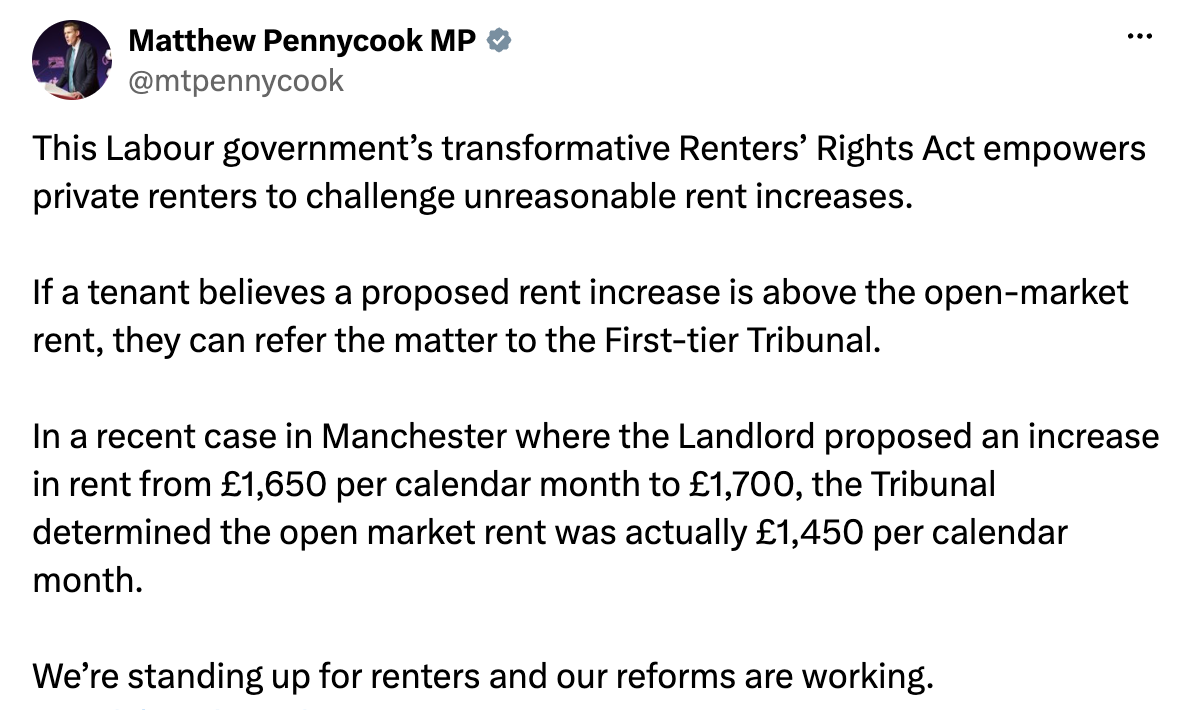
But landlords may see it differently.
What happened?
The landlord in question served notice to increase the rent on a two-bed, sixth-floor flat in central Manchester from £1,650 to £1,700 a month.
The tenant challenged it at the First-tier Tribunal, arguing that similar flats in the building were renting for around £1,400. She also pointed to basic furnishings and some maintenance issues as further evidence.
The landlord argued that his was the largest flat in the building, on the top floor, with better light and views than its neighbours.
The tribunal agreed it was an attractive, high-spec flat. But then it set the rent at £1,450 anyway.
Why did the landlord lose?
It all came down to evidence.
The tribunal preferred rents that had been achieved in the same building, or in similar buildings nearby, over the asking prices listed on the portals. The tenant brought those numbers. The landlord’s evidence didn’t carry the same weight.
He also asked for a hearing and an inspection, so the tribunal could see the light and views for itself. Both were refused, and the case was decided on paper.
So a £50-a-month rise has turned into a £2,400-a-year cut, and a handy lesson in how not to raise the rent.

What it means for you
This goes beyond one flat in Manchester.
We spent a thrilling afternoon going through all 73 rent decisions published since 1 May, and the good news is that this landlord’s outcome is rare. Only 4% of cases ended with the rent cut below what the tenant was already paying.
The less good news is that only 40% of landlords got the full increase they asked for. In 41% of cases, the tribunal awarded a smaller rise, and in 15% it awarded nothing at all.
Small increases aren’t safe either. This landlord was asking for about 3%, and even among rises of 10% or less, our research showed that only 53% went through in full.
Meanwhile, because a tribunal will never set the rent higher than the landlord proposed, challenging a rise costs tenants very little. In total, 85% of those who challenged came away with a lower rent, a delayed increase or both.
It’s no wonder some campaign groups are encouraging tenants to flood tribunals with challenges, whether the increase is fair or not. Because no matter the outcome, at £47 for an application, it’s a cheap way to buy some time.
What separates a successful increase from a failed one?
When you dig into the individual decisions, clear patterns emerge that give you a better view of what’s working and what isn’t.
You can still put the rent up. Just do the homework first:
- Find achieved rents for comparable properties: ideally in the same building or street if you can.
- Fix any outstanding repairs before you serve notice, because the tribunal will look at the property as it is.
- Think about whether the tenant can afford the increase, and what a void would cost you if they leave.
- Use the correct Section 13 form, give at least two months’ notice, and remember you can only increase the rent once a year.
The landlords who are winning treat the Section 13 process seriously. They present solid comparables, keep their increases reasonable, and build a case (with evidence) that can stand up to scrutiny.
Planning a rent increase? We’ve put together a free guide that walks you through the Section 13 process step by step.